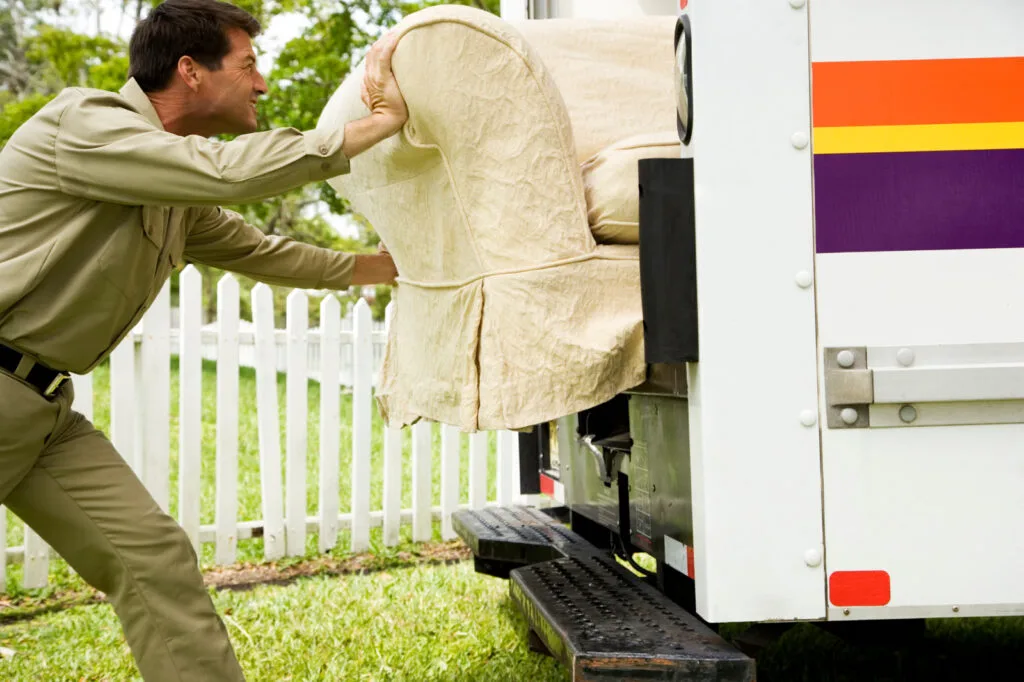
Moving Labor Guide — Charleston, SC
Labor-only movers load, stack, and secure your things into a truck or container you rented — you drive it. Charleston labor-only help averages about $85.90 an hour (HireAHelper, August 2026); Low Country Moving’s published labor-only rates run $115 to $195 an hour by crew size, two-hour minimum. The catch: once you pull away, transit damage is generally yours.
Updated September 2026 · 8 min read · Serving the Lowcountry since 2008
The short version:
- You rent the truck. We do the heavy part. The crew carries, pads, stacks, and straps. You drive.
- Charleston market rate: about $85.90 an hour, typical totals $300 to $625 (HireAHelper, August 2026).
- Our labor-only rates run below our full-service rates — $115 to $195 an hour by crew size, two-hour minimum, covering packing, unpacking, loading, and unloading of your rental truck.
- The part most guides skip: a crew’s responsibility covers the handling. Once you drive off, road damage is yours unless you’ve bought coverage from the rental company.
- Same service works for PODS-style containers, which load a little differently.
Renting the truck and hiring the muscle is a good deal on a lot of Lowcountry moves. It also shifts one real risk onto you. Here’s how it works, what it costs, and where the responsibility line sits.
1. What labor-only moving is — and what it isn’t
Labor-only moving — also called moving labor, loading help, or a hybrid move — means you supply the vehicle and we supply the crew. That vehicle can be a rental truck or a portable container in your driveway.
What the crew does
- Pads and protects your furniture. Dollies, furniture pads, and straps come with in-town jobs.
- Basic disassembly — bed frames, table legs, anything that has to clear a door.
- The carry — stairs, upper floors, long walks to wherever the truck could legally park.
- The stack — front to back, floor to ceiling, so the load doesn’t shift.
- Securing it — strapping each section to the truck’s tie-off rails before starting the next.
- The same thing in reverse. Unload-only is a normal booking.
- Packing and unpacking, if you want boxes handled too.
What the crew won’t do
- Drive your rental truck. That’s the line that defines the service, and the reason the price is different.
- Hook up or unhook a tow dolly or car carrier. Practices vary by company — ask when you book.
- Load hazardous materials. Propane, gasoline, paint thinner, and aerosols are restricted. Perishables and live plants are a bad idea too; a closed truck gets brutally hot here. Your rental agreement has its own restrictions.
- Vouch for someone else’s stacking. If a different crew loaded the truck and we’re only unloading, say so in advance.
2. When labor-only is the right call
It usually wins when:
- Budget is the constraint. A rental truck plus a crew for the hard part is the cheapest way to move without wrecking your back.
- Your move ends somewhere else — but the loading happens here. We’re a local Lowcountry mover: our trucks and crews work Charleston, Berkeley, and Dorchester counties, and we don’t transport anyone out of state. If you’ve rented a one-way truck for a move that ends elsewhere, the Charleston loading is the part you can hire locally — your truck, your drive, your move; our labor at the origin and nothing past the curb.
- You’ve got a portable container. The container company drops and hauls it, so loading is the only labor piece involved.
- You only need half the job. Plenty of people load themselves over a weekend and hire a crew just to unload.
- You’re moving inside one building, or shuffling a house into a storage unit.
Full service tends to win when your building or HOA requires a certificate of insurance naming the moving company (many downtown buildings and condo associations do — ask early); when you have specialty items like a piano, a gun safe, or marble tops; when a full-size truck can’t reach your door downtown; or when you’d rather not drive a 26-foot truck over the Ravenel Bridge in July.
3. What labor-only costs in Charleston
The market number
Current market data from HireAHelper (August 2026) puts the average labor-only rate in Charleston at about $85.90 an hour, with typical totals landing between $300 and $625.
Treat that as a planning baseline, not a quote — and note what it excludes. Truck rental, fuel, mileage, pads, and counter add-ons are separate lines in your budget.
Our published rates
Labor-only is the least expensive way to book our crews — you aren’t paying for the truck, so the hourly rate sits below our full-service rate. Two-hour minimum:
| Crew | Hourly rate |
|---|---|
| 2 movers | $115 |
| 3 movers | $135 |
| 4 movers | $155 |
| 5 movers | $175 |
| 6 movers | $195 |
That rate covers the labor of packing, unpacking, loading, and unloading your own rental truck or container — packing supplies are an additional charge — and our published terms provide dollies, furniture pads, and straps on in-town jobs. Current rates are on our service rates page.
Why the two numbers are different
An hourly rate is a bundle, and what’s inside varies from company to company — crew training and background checks, the equipment that shows up, the company’s own liability and workers’ compensation coverage, and whether you get the crew that runs the full-service jobs. Cheaper hourly help exists here and works out fine on plenty of moves. The useful step isn’t picking the lowest number; it’s asking any crew — ours included — what’s inside theirs.
And hours matter more than the rate. A four-person crew that loads a three-bedroom in half the time a two-person crew needs can cost less overall.
4. Loading a rental truck so it survives the drive
A rental truck doesn’t ride like a moving van — stiffer, emptier, and driven by someone who doesn’t do it for a living. Loading it well is most of what protects your things.
Weight low, forward, and balanced
The heaviest items — appliances, safes, dressers, tool chests — go in first, low, against the front wall behind the cab. Weight over the axle and forward of it keeps the truck stable. Too much at the tail makes a truck sway; too much on one side pulls the steering all day. Balance left to right.
Build in tiers
Load in vertical walls, front to back. Each tier goes floor to ceiling: heavy on the bottom, lighter going up, soft goods filling the gaps. A load with headroom is a load with somewhere to topple. Boxes stack best uniform — same-size cartons, heaviest on the bottom, nothing pyramided.
Strap every tier before starting the next
Rental trucks have tie-off rails or logistics tracks along the walls. Use them at each tier rather than throwing two straps over the whole load at the end. Friction and a tight fit are not a securing method — the first hard stop on Highway 17 proves it. Stuff the voids as you go; pillows and linens wedged into gaps stop the rattling.
Protect what’s most likely to get hurt
- Mattress bags. Truck floors and walls are dirty, and a mattress rides against them the whole way.
- Blanket-wrap furniture, and tape to the blanket — never to the finish.
- Mirrors, glass tops, and TVs travel upright, padded and sandwiched, never flat under anything.
- Empty the heavy drawers. Light clothing can stay; books and tools can’t.
- Defrost and dry the refrigerator about 24 hours ahead, and install the transit bolts on a front-load washer drum.
- Label boxes by room, on the top and one side, so nothing gets stacked wrong.
More prep is in our moving tips.
5. ⚠️ The liability gap nobody explains
This is the part worth reading twice, because almost nobody hears it before move day.
What a loading crew is responsible for
A labor-only crew is responsible for how your belongings are handled on your property — the carrying, padding, stacking, and securing. If a crew member puts a dresser through your stair rail, that falls on the crew’s side of the line.
What happens the moment you drive away
Once the door rolls down and you turn the key, the person responsible for that load is the person driving it. That’s you. If the truck stops short and a bookcase comes down, that damage generally sits with you rather than the crew that loaded it — the exception being damage that traces back to how the load was built. Our own published labor-only terms say it plainly: coverage applies during the packing, loading, and unloading, and liability ends once the movers leave the premises. Within that window you choose between full value coverage with a $1,000 deductible and the $.60-per-pound option — and neither is insurance; both are valuation, a contractual limit on what we owe.
Why it works that way
For moves that cross state lines, federal law puts responsibility for goods in transit on the motor carrier — the company that actually hauls them. That’s where the Carmack Amendment (49 U.S.C. § 14706) and the released-value framework in 49 CFR Part 375 live. A labor-only crew never operates the vehicle, so it isn’t acting as the motor carrier for that trip. Those federal transit protections don’t attach to the driving portion of a labor-only move.
Two things to keep straight. First, that framework governs interstate moves specifically. A move staying entirely inside South Carolina is regulated by the SC Public Service Commission and enforced by the Office of Regulatory Staff under a separate set of rules, with in-state household-goods carriers operating under a PSC Class E certificate. Second, none of this is insurance. What a mover offers on its own trucks is valuation — a contractual limit on what the company owes you — not a policy from an underwriter.
What to do about it
- Ask the rental company what coverage they sell and what it covers — the truck, the contents, or both. These products vary, you add them when you book or at the counter, and coverage for your belongings on the road is never automatic. Read the exclusions too: shifting loads, poor packing, and prohibited contents are common ones.
- Call your homeowner’s or renter’s insurance agent. Some policies cover goods in transit; many don’t. Ask directly instead of assuming.
- Photograph valuable items before loading, including damage that’s already there. Timestamps settle arguments.
- Get the handling terms in writing with your quote. Ask us and we’ll put ours next to the estimate — and our guide to what your mover actually owes you if something breaks explains how valuation works on a move that stays inside South Carolina.
None of this is a reason to avoid labor-only. It just comes with a job you’re taking on personally — the drive — and that’s where the risk lives.
6. Loading a PODS or portable container
Containers are their own puzzle, and loading them is one of the jobs we take.
- Weight still matters, differently. There’s no axle to balance over, but the container gets lifted and hauled — keep heavy items low and spread front to back.
- Tighter opening, fixed ceiling. Tiering matters more here, not less. Fill to the top, and pick up extra rope or straps if the unit is short on anchor points.
- It’s going to sit outside. Lowcountry humidity is unkind to a sealed metal box. Don’t load anything damp, keep mattresses bagged, and think twice about candles and electronics riding out an August in a driveway. Check your HOA, too — some limit how long a container can sit.
- The handoff is the same. Once the container leaves, the container company’s terms govern what happens to it in transit. Ask what their coverage does before you sign.
7. Charleston and Summerville logistics worth planning around
- Peninsula access. Historic downtown wasn’t built for box trucks. Narrow streets, cobblestone, and no legal parking near the door are routine, and a 26-foot rental may not fit your street at all. Check before you reserve a truck size — and note that the City of Charleston requires a permit to block a street or parking space with a moving truck — confirm the permit type with Traffic & Transportation.
- Summerville, Goose Creek, and Moncks Corner are usually the simpler end: driveways, ground-floor access, room to park. The variable out there is drive time.
- Heat and timing. Highs run past 90°F from June through August, so start early. Peak season runs May through September with July the busiest month, and peak pricing runs roughly 20–30% above winter rates according to moveBuddha’s 2026 market data. Mid-week, mid-month dates are the easiest to get on our schedule, and rental trucks are easier to reserve then too.
Frequently Asked Questions
Who can load my rental truck in Charleston, South Carolina? Professional moving crews offer this as a standard service, usually called labor-only or moving labor. We do it across the tri-county area — Charleston, Mount Pleasant, Summerville, Goose Creek, and Moncks Corner — at our published labor-only rates, $115 to $195 an hour by crew size, two-hour minimum. You supply the truck; we load it.
Can I hire movers to load a U-Haul in Summerville, SC? Yes. Loading a rental truck in Summerville is a routine labor-only job. Tell us the truck size, whether there are stairs, and how far it can park from the door, and we’ll size the crew to the house.
How much does labor-only moving help cost in Charleston? Market data from HireAHelper puts the Charleston average at about $85.90 an hour as of August 2026, with typical totals between $300 and $625. Our published labor-only rates run $115 to $195 an hour by crew size, two-hour minimum — below our full-service rates, because the truck and the drive are yours. Hourly rates bundle different things, so ask what’s included before comparing two numbers.
Do I need to provide my own straps, blankets, and dollies? Our published terms provide dollies, furniture pads, and straps on in-town jobs, so the crew arrives with what it needs to move and protect your things. What our equipment doesn’t do is ride away with you — if the truck is driving somewhere the crew isn’t, the padding and tie-downs that stay with your load are usually rented or bought at the truck counter.
What happens if something breaks in transit after the crew loads my truck? That damage is generally yours. A loading crew’s responsibility covers handling your belongings on your property. Once you close the door and drive, you’re the one transporting the goods — and because the crew isn’t operating the vehicle, the federal transit rules that apply to interstate carriers don’t attach to that leg. The rental company may sell coverage at the counter, but you have to buy it. Ask your own insurance agent as well.
Ready to Skip the Heavy Half?
We’ve been moving Lowcountry families since 2008, and this is one of the jobs we do: your truck, our crew, one hard morning instead of a hard weekend.
Get a free, no-obligation estimate and we’ll size the crew, flag what makes move day run long, and put the terms in writing.
Call (843) 737-1279 or contact your local mover. Or request a time through our booking page.
See our current service rates or browse more moving tips.
This article explains general regulatory frameworks and is not legal advice. Coverage and liability terms vary by company — always ask for yours in writing.