Moving Guide — Charleston & Mount Pleasant, SC
On a local hourly move, taking furniture apart and putting it back together is absorbed into the time you’re already being billed for — not charged per item. Our full moving service includes basic disassembly and furniture blankets. The per-item disassembly fees you’ll see online, roughly $50 to $350, come from national flat-rate pricing — not local hourly jobs.
Updated September 2026 · 8 min read · Serving the Lowcountry since 2008
The short version:
- On an hourly local move, breakdown time is just time. There’s no separate per-item charge for it.
- Basic disassembly and furniture blankets are included in our full moving service.
- The pieces that almost always come apart: beds, L-shaped and executive desks, armoires, sectionals, dining tables, exercise equipment.
- Those $50–$350-per-item numbers are national, and they mostly describe flat-rate pricing — a different kind of move than a Charleston hourly job.
- Hardware is the real risk, not the labor. Bolts get bagged, labeled, and taped to the piece they came off.
If you’ve been searching for what a Mount Pleasant or Charleston mover charges to break down a bed frame, you’ve probably found a lot of per-item price lists. Most describe a different pricing model than the one your local move will use.
1. On an hourly local move, disassembly isn’t a line item
There are two pricing models in this industry, and they treat furniture breakdown completely differently.
Itemized, inventory-based pricing — common on long-distance moves, where totals build from a shipment inventory plus weight and distance — can attach a number to individual services, so disassembling a bed becomes its own line with its own price. That’s where the per-item fee lists come from.
Local hourly pricing — how moves inside South Carolina are typically billed — doesn’t work that way. You’re paying for crew time, and the truck, equipment, and labor come with the hour. If it takes two movers 20 minutes to break down your platform bed, you paid for 20 minutes of two movers. There’s no second fee stacked on top.
So, plainly: on a full-service local move with us, basic disassembly doesn’t come back as a per-item charge at the end of the day. Our full moving service includes basic disassembly and reassembly, furniture blankets, and the equipment to do it — dollies, straps, tools, floor protection. Specialty items are the exception, and they’re named below. Putting the pieces back together at the destination is part of the same job.
One practical tip: ask the crew to rebuild the beds first, before the boxes come in. It’s the one piece you’ll actually need that night, and it’s far easier in an empty room.
2. What “basic disassembly” covers — and what gets quoted separately
Included in a standard full-service move
The everyday breakdown a crew typically handles with hand tools and an Allen wrench — with the exact scope for your move stated in the written estimate:
- Bed frames — headboards, footboards, rails, slats
- Desks that come apart at the top, legs, or return
- Table legs and table leaves
- Sectional connectors and modular seating
- Mirrors detached from dressers; shelving and closet systems that unbolt
- Taking a door off its hinges, with your OK, when a piece won’t otherwise clear the opening
Reassembly of those same pieces at the destination is part of the job, not an add-on.
Quoted separately
Specialty pieces need different equipment and a different level of care. They belong in the written estimate — point them out at the walk-through so they’re priced before move day rather than discovered on it:
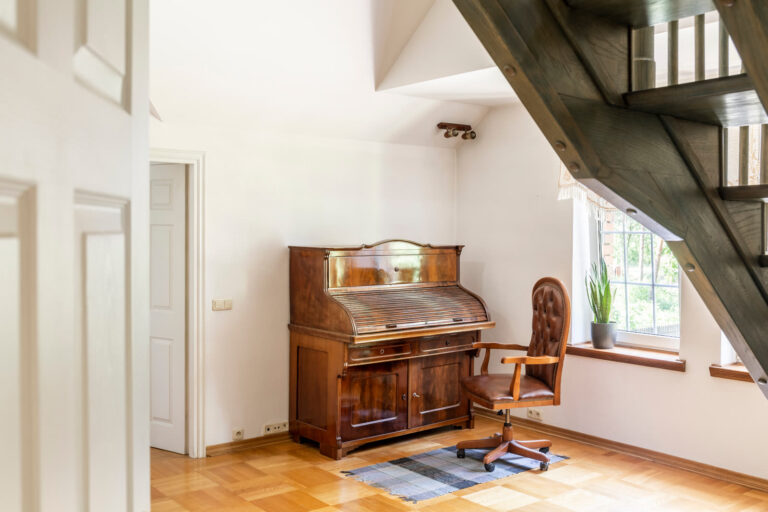
- Upright pianos — quoted by phone. We move them with full service or as a standalone job; the price depends on the piano, the access, and the layout.
- Exercise equipment and motorized beds — named on our rates page as specialty items that carry an additional charge, so they belong in the estimate.
- Gun safes, antiques, and fine art — priced in your written estimate.
- Furniture delivery (a new piece coming from a store or warehouse) — quoted on request.
We’d rather show you the specialty number in your written estimate than surprise you with it in your driveway.
3. Which pieces almost always come apart — and why
The three reasons anything gets taken apart
The opening. A king headboard, a full-size armoire, or an L-shaped desk won’t fit through a typical interior doorway assembled. Downtown Charleston’s older homes make it harder — original door frames and piazza doors were built to smaller dimensions than modern furniture assumes.
The turn. Getting a piece down a hallway is one problem; getting it around a stair landing is another. Peninsula and older Mount Pleasant homes are full of tight quarter-turn stairs, and elevated island homes add an exterior flight. A piece that clears every doorway can still be beaten by one landing.
The truck. This one people underestimate. Road vibration works fasteners loose, glass and stone tops flex, and a tall assembled piece is a tipping risk when the truck brakes. Taking a piece apart is often the safest way to move it, not just the only way out of the house.
The usual list
- Bed frames. Nearly always. Headboards, rails, slats, and platform bases all come apart, and modern storage beds have more fasteners than people expect.
- L-shaped, executive, and sit-stand desks. The next most common breakdown after beds. Returns, bridges, and heavy tops are separate pieces bolted into one unit.
- Armoires, wardrobes, and tall storage. Doors, mirrors, and shelves come off; some units are two stacked cases that separate.
- Sectionals and modular seating. A sectional that came into the house in three pieces has to leave the same way — connectors release and legs unscrew.
- Dining tables. Legs and pedestals come off, leaves come out, and glass or stone tops get wrapped and carried upright — flat glass is stronger on edge than on its face, which is why it rides vertical and never flat under anything.
- Exercise equipment. Treadmills fold or split, multi-station gyms come down to a frame, and cables and weight stacks get secured separately — this one is a specialty item on our rates page, so it gets priced in the estimate rather than absorbed into the hour.
Cribs, bunk beds, and large wall units belong on the list too. If you’re unsure about a piece, point it out during the walk-through.
4. What per-item disassembly pricing looks like nationally
If you searched this topic before landing here, these are probably the numbers you found — and it’s worth knowing where they come from.
National figures compiled in 2025–2026 industry data:
| Service | Typical national figure |
|---|---|
| Standard furniture disassembly | ~$50–$350 per item |
| Specialty-tool labor, after the first hour | ~$20–$40 per person, per hour |
| Pool tables (movement plus re-leveling) | ~$200–$600 |
Three honest caveats about that table:
- These are national averages, not Charleston prices. Line-item disassembly pricing specific to the tri-county market is thin in the published data. Treat them as background, not a local quote.
- They mostly describe flat-rate pricing, where each service is itemized on an inventory. On a local hourly move, the same labor shows up as time on the clock instead.
- The spread is enormous — $50 to $350 is a seven-fold range, which tells you the “average” isn’t describing one thing. A nightstand and a nine-foot sectional are both “an item.”
Where per-item pricing does hold up is specialized handling — pianos, safes, pool tables, oversized gym equipment. We price those in your written estimate before move day.
5. Our published rates, so you can do the math yourself
Because disassembly time is billed as time, the main number you need is the hourly rate — packing supplies and specialty items are the separate lines to ask about.
Full moving service — labor, truck, and equipment included, two-hour minimum:
| Crew | Hourly rate |
|---|---|
| 2 movers | $135 |
| 3 movers | $155 |
| 4 movers | $175 |
| 5 movers | $195 |
| 6 movers | $225 |
For context, moveBuddha’s July 2026 Charleston dataset puts the market average for a full-service local crew near $134 an hour. Our full published list, including our separate labor-only rates, is on our service rates page.
So the math is simple. Three movers at $155 an hour is about $2.58 a minute across the whole crew. Fifteen minutes on a bed represents about $39 of crew time on the clock. Those minutes cost the same whoever is doing what — but because the rest of the crew keeps loading while one or two people break the bed down, the breakdown usually doesn’t add fifteen minutes to the job. Either way: no separate fee.
There’s a strategy point in that: a larger crew can cost less overall, because breakdown and loading happen in parallel. Sizing the crew down to save on the hourly rate can add more hours than it saves.
6. The craft that protects your furniture
Anyone can take a bed apart. Putting it back together correctly, in a different house, six hours later, is where the skill actually lives — and where furniture gets ruined by crews that cut corners.
Hardware gets bagged, labeled, and taped to the piece
The discipline to insist on from any crew you hire, ours included — ask and we’ll confirm it for your job: every bolt, cam lock, washer, bracket, and Allen key goes into a labeled bag, and the bag stays secured to the piece it came off — fixed to an unfinished surface like the underside, never taped to the finish.
Not in a toolbox. Not in a communal “hardware box.” With the furniture. Hardware that travels separately from its furniture is a common reason reassembly stalls at the new house, and generic replacement bolts rarely match the thread pitch on modern furniture.
Photos before anything comes apart
A photo of the piece assembled, and a second of the joint before the fasteners come out, takes ten seconds and removes the guesswork later. It also documents the piece’s pre-move condition, which matters if there’s ever a question about damage.
Manufacturer hardware and instructions
If you still have the original assembly instructions or a spare-parts bag, keep them with that piece rather than in a box. Manufacturer hardware is specific — cam locks, threaded inserts, and proprietary brackets aren’t interchangeable across brands, and a hardware-store substitute often won’t hold.
An honest word about flat-pack furniture
General guidance rather than a rule, but worth knowing before move day: ready-to-assemble furniture doesn’t come apart and go back together indefinitely.
Particleboard and MDF pieces hold their strength through cam locks and threaded inserts driven into engineered board, and repeated disassembly can loosen that seat, depending on the piece and its condition. A wardrobe or bookcase that won’t tighten back up is a wobble risk, not just a cosmetic one.
Practically:
- If a flat-pack piece will clear the doors and stairs assembled, moving it assembled and blanket-wrapped is often the better call.
- If it has to come apart, it comes apart slowly — the damage happens at the joint, not in the truck.
- For a piece that’s already been through a couple of moves, it’s fair to ask whether it’s worth moving.
Solid wood, quality veneer, and metal-framed furniture are generally built to be taken apart and reassembled, so they hold up better to it — though joinery, fasteners, and prior damage still matter.
7. What to sort out before move day
A short checklist that keeps the clock down and the furniture intact:
- Point out every piece that needs breaking down during the walk-through — especially exercise equipment, wall units, and anything with a glass or stone top.
- Say which room each piece is going to at the new house. Reassembling a bed in the wrong bedroom means doing it twice.
- Flag specialty items early. Pianos, safes, antiques, and fine art belong in the estimate, not sprung on the crew.
- Empty the pieces first — dresser drawers, desk drawers, and armoire shelves, before anyone touches a fastener. Keep any original hardware or instructions with the piece they belong to.
- Ask what’s included, in writing. The estimate should state the hourly rate, crew size, minimum, travel or drive-time charges, and what basic disassembly covers.
If something is damaged during a breakdown
Worth understanding before you need it: what a mover offers on loss or damage is valuation — a contractual limit on what they owe you, not insurance. For a move that stays entirely inside South Carolina, those terms come from the tariff the mover files with the SC Public Service Commission, not the federal rules national moving sites describe. Ask any local mover to put their coverage terms in writing with the estimate. More on that in our guide to what your mover actually owes you if something breaks.
Frequently Asked Questions
How much does furniture disassembly cost for a home move in Mount Pleasant? On a local hourly move it isn’t priced separately — the breakdown time is part of the hours you’re already billed. Our published rates run $135 an hour for two movers up to $225 for six, two-hour minimum, truck and equipment included. The $50-to-$350-per-item figures online come from 2025–2026 national data and describe flat-rate pricing, not a local hourly job.
Is furniture disassembly included, or is it an extra charge? Basic disassembly and reassembly are included in our full moving service, along with furniture blankets. Specialty pieces are the exception — upright pianos, safes, antiques, and fine art are quoted after we’ve seen them and priced in your written estimate.
Which furniture usually has to be taken apart for a move? Bed frames, L-shaped and executive desks, armoires and wardrobes, sectionals, dining tables with legs or leaves, and exercise equipment are the routine ones; cribs, bunk beds, and large wall units usually make the list too. The reason is almost always doorway width, a stair turn, or transport safety in the truck.
Will the movers put my furniture back together at the new house? Yes — basic reassembly of the pieces we took apart is part of the same job on a full-service local move; specialty and flat-pack pieces are the exceptions worth naming in the estimate. Ask the crew to rebuild the beds first, before boxes fill the rooms, so you have somewhere to sleep that night.
How much does it cost to move a piano in Charleston? We move upright pianos with full service or as a standalone job, and we quote them by phone — the price depends on the piano, the location, and the layout, so there’s no single published number. Call (843) 737-1279 and describe the piano and the access, and we’ll price it.
Do I need to take my own furniture apart before the movers arrive? Usually not. On an hourly move most people come out ahead letting the crew do it — they have the tools, hardware gets bagged and labeled to the piece, and they know which items are safer moved assembled. Ask what your mover includes and permits, since some pieces they’ll want to handle themselves. What saves you money is having drawers emptied and boxes packed and closed before the crew walks in.
Ready for a Move That Ends With Your Furniture Back Together?
We’ve been moving Charleston, Mount Pleasant, Summerville, Goose Creek, and Moncks Corner families since 2008 — through narrow peninsula stairwells, up island pilings, and around a lot of door frames built before king beds existed. Basic disassembly and reassembly come with the job, and our rates are published so you can check the math first.
Get a free, no-obligation in-home or virtual estimate. We’ll size the crew, flag the pieces that have to come apart, and price any specialty items in writing up front.
Call (843) 737-1279 or contact your local mover.
See our current service rates or book your move online.